Reading a Policy Announcement Without Mistaking It for Implementation
Learn how to read a policy announcement, trace its formal status, and identify the current agency instructions before deciding whether or how to act.
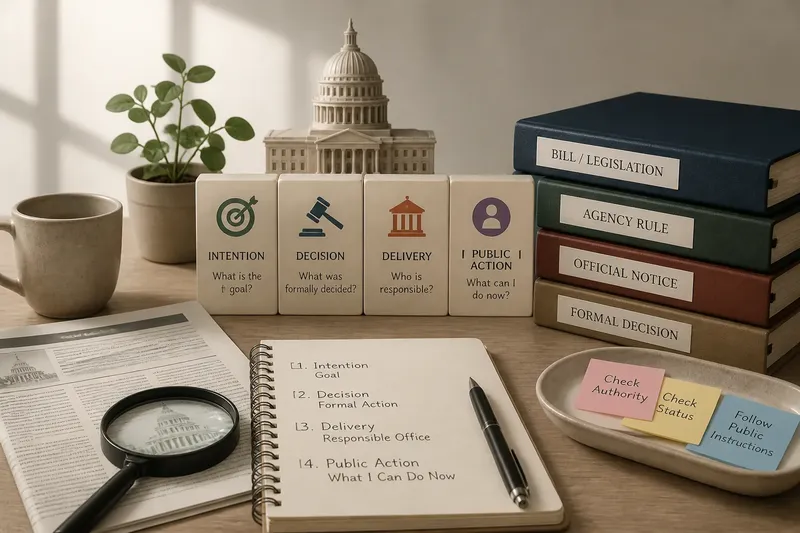
Has a policy announcement changed what you can do today? Reading a policy announcement carefully means checking its formal status and the current instructions from the office responsible for carrying it out. A confident headline can describe a goal, a decision, or a service already open to the public; those are different things.
Read the action verb
Start with the wording that describes what happened. “Plans to create,” “will develop,” and “aims to” point to intention or future work. “Issued a rule” or “signed a bill” names a formal action, though it still may not mean that people can use a service or must follow a new requirement today.
Separate four claims as you read:
- Intention: What outcome does the speaker want? If the announcement only states a goal, treat it as a commitment rather than a usable instruction.
- Decision: What did an authorized institution approve or issue? If no formal action is identified, look for the bill, rule, resolution, or decision before treating the proposal as settled.
- Delivery: Which office is responsible for carrying it out? If none is named, ask the issuing institution who will administer it.
- Public action: What can an affected person do now? If the announcement gives no current form, process, or effective date, do not infer that applications or obligations have begun.
This distinction helps avoid treating a political promise as an available service, enforceable rule, or instruction to the public.
Check the authority
A press release, legislative vote, agency regulation, and signed law are not interchangeable. Each may belong to the same policy process, but each records a different kind of action. Ask which institution had authority to take the step described and whether another approval is still pending.
Look for the underlying record named in the announcement: a bill, adopted resolution, published rule, agency notice, or formal decision. Check whether it is proposed, adopted, signed, issued, or sent onward. A law may authorize a program while leaving an agency to set details; an agency rule may leave local offices to manage applications.
If the announcement says that action depends on a vote, later approval, or another institution’s decision, that condition is part of the current status. Do not treat a planned next step as completed just because the announcement describes what officials expect to happen.
Track the formal status
Labels such as “draft,” “proposed,” “final,” “adopted,” and “effective” help identify a document’s stage. A draft may invite public comments; a final rule may still have an effective date in the future. Check the document itself rather than relying on the shorthand in a headline.
Read dates in context. A publication date shows when a document appeared; an effective date says when its provisions are scheduled to apply. A deadline may bind an agency, an applicant, or the public, so check who must act and what the document says happens next.
Say a city announces discounted transit passes for qualifying residents. The announcement says the council approved a budget request, but the fare agency has not issued eligibility rules or application instructions. A resident can identify the intended benefit, but the missing agency rules mean there is no basis to assume applications are open; the next useful signal is a formal notice explaining who qualifies and how to apply.
Follow the public instructions
For a person affected by a policy, the most useful question is often not which institution designed it, but what the responsible office currently tells the public to do. Look for an application opening, revised form, service notice, enforceable rule, or instruction to regulated organizations. A usable notice should identify the relevant people, the process, and when it applies.
Compare the announcement with the material people are expected to use. A press release might describe a housing protection while the agency page explains which complaints it accepts and how to submit them. If the sources differ, keep the discrepancy visible instead of combining them into a broader promise.
For legal, financial, or eligibility questions, use public information as a starting point. Ask the responsible office which instruction is current; if the difference affects a right, deadline, or significant decision, consult a qualified professional.
Questions about status?
Does an announcement create a legal right?
Not necessarily; the answer depends on the authority, document, and action involved. Check the formal instrument and its effective terms rather than relying on a headline.
How can I spot a proposal?
Look for “draft” or “proposed,” an invitation to comment, or a pending vote or approval. The document’s status and issuing authority matter more than confident speech language.
Where can I find current instructions?
Start with the public office responsible for administering the policy and look for its latest forms, notices, or guidance. If no office is named, ask the institution that issued the announcement who will provide instructions.
What should I do if sources conflict?
Keep the announcement and agency guidance, note the specific difference, and ask the responsible office which instruction currently applies. If the conflict affects a legal right or important deadline, seek qualified advice rather than guessing.
Keep a status record
A short note can help you return to the issue without relying on a headline or memory. Record the announcement’s exact action, the formal document and its status, the office giving current public instructions, and the next signal you are waiting for.
- Announcement wording: If it says “plans” or “intends,” record the proposal as pending; if it names an issued action, locate the formal document.
- Authority: If the named institution has power to take the stated action, check its decision record; if authority lies elsewhere, identify the institution whose action is still needed.
- Document status: If the record says “draft” or “proposed,” treat it as unsettled; if it says “adopted” or “final,” check whether it has taken effect.
- Effective date: If the date is in the future, follow current instructions until it arrives; if no date appears, ask the responsible office when the change applies.
- Public process: If a current form or application notice is available, follow that source; if not, ask the agency whether people can act yet.
- Conflicting guidance: If the announcement and agency page disagree, preserve both and request clarification; if the answer affects a deadline or right, consult a qualified professional.
For example, imagine a tenant reads that a city “will expand” rental assistance. She records that the announcement describes a future plan, checks the city council’s public record, and finds a budget request rather than an adopted program. She then checks the housing agency page and finds no new application notice, so her status note says “proposal pending; no new instructions posted.” The practical answer is to use the agency’s existing guidance for any current need and watch for a formal program notice before relying on the proposed expansion.
When reading a policy announcement, that record keeps the question grounded in what the public office has actually instructed people to do. It also makes the next move clearer: follow current guidance, ask for clarification, or wait for the formal notice that changes it.