Consultation or Deliberation? Two Ways to Gather Public Views
Consultation or deliberation: choose the public engagement method that fits your decision, gather useful input, and understand what each process can reveal.
Consultation or deliberation—which should a public agency use when residents’ views could shape a proposed change? Consultation gathers reactions to a defined question or proposal; deliberation gives people time to examine competing reasons and weigh options.
They are not interchangeable ways to collect comments. The right choice depends on what the decision needs from the public, what remains open to change, and how officials will use the input.
Start with the decision
If officials have a draft policy and need to learn what works, what causes trouble, or what has been overlooked, consultation is often the better fit. People can comment on a proposed bus route, a school boundary map, or a draft rule. Their responses can identify practical barriers and show which parts need revision.
Consultation can also help when an agency needs input from people who may not be able to attend a meeting. A web form, mailed questionnaire, phone line, or open house offers different ways to respond. The agency should say what is still open to change; otherwise, an invitation for views can sound like a decision already made.
Choose deliberation when a public question involves competing goals that cannot all be achieved at once. Residents may need to weigh faster emergency response against neighborhood traffic, or lower utility bills against a more resilient energy system. Structured discussion gives participants room to consider those tradeoffs before offering advice.
Deliberation can help decision-makers understand what people think after engaging with reasons that differ from their own. It does not turn participants into a miniature version of the whole public, and it does not transfer legal authority to them. Its value is in making considered judgments and the reasoning behind them visible.
Match method to purpose
- Use consultation for local knowledge. Ask residents where a proposed service location would be hard to reach or which parts of a draft form are confusing. If responses identify a barrier, revise the location or form; if they do not, keep the draft but check that the question was clear.
- Use consultation for varied responses. If an agency needs input from a large or dispersed group, offer several ways to respond. If comments reveal recurring concerns, address them in the draft; if they conflict, report the disagreement rather than treating one view as the public’s verdict.
- Use deliberation for real tradeoffs. If options have different costs, benefits, or effects on groups, organize a facilitated discussion. If participants can compare the consequences, use their advice to clarify priorities; if the options are not yet clear, define them before asking for a recommendation.
- Use deliberation when informed judgment matters. If a short notice cannot explain a difficult decision, provide balanced background materials and time for questions. If participants still lack essential information, pause for clarification; if they can weigh the options, invite their considered advice.
- Use both for distinct stages. Consultation can gather lived experience before a deliberative group examines a smaller set of choices. If the stages answer different questions, explain how the first informs the second; if they repeat the same request, revise the plan or explain why input is being sought again.
- Choose consultation when the issue is already bounded. If officials need feedback on a defined draft, open a comment channel and state what can change. If the central question is still which goals to prioritize, use deliberation instead of asking residents to react to an incomplete proposal.
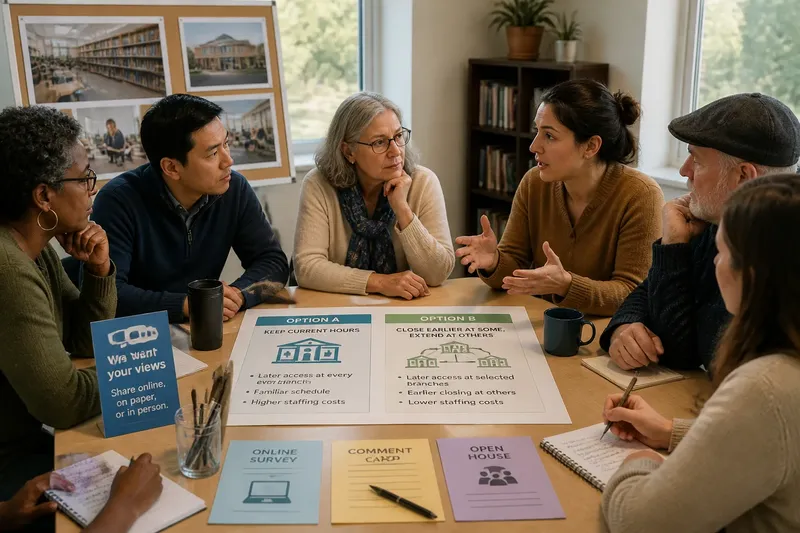
Say a county is considering changes to a library’s evening hours. It starts with two options: keep the current schedule or close earlier at some branches while extending hours at others. The county invites consultation through an online survey and paper cards, asking residents which days conflict with work, caregiving, or transit; if responses point to a specific access problem, officials can adjust the draft schedule, and if they do not, they can retain the options while reporting that no common barrier emerged. Officials then recognize that the options trade later access at fewer branches against earlier access across more branches. They give a deliberative group materials describing those choices, invite questions, and ask participants to weigh who would be affected. If the group identifies conditions that make one option more acceptable, officials can consider those in the final decision; if views remain divided, the county should report the disagreement rather than imply consensus.
Read the results carefully
Consultation is good at surfacing concerns, suggestions, and experiences. Its openness can be a strength: someone may raise an issue the agency did not anticipate. But people who respond are self-selected, and the volume or intensity of comments does not establish how common a view is across the population.
That limit does not make consultation unhelpful. Officials can report recurring themes, note conflicting feedback, and explain how comments affected the draft. They should not present an open comment period as a public vote or claim that the loudest response represents everyone.
Deliberation offers a different kind of information: participants’ judgments after shared discussion and consideration of alternatives. A carefully designed process can help people identify what they value, where they disagree, and what conditions might make an option more acceptable. The result may be nuance rather than consensus.
A small group cannot speak for every resident simply because its discussion is thoughtful. Participant selection, briefing materials, facilitation, and the framing of options all shape what the group can consider. Decision-makers should describe those choices and treat the group’s output as advice, not a mandate.
Questions that guide choice?
Do people need to react or weigh options?
If the agency wants comments on a draft, consultation is usually the direct route. If people need to compare competing aims and consider reasons together, deliberation is more suitable.
Is the proposal settled or still open?
Consultation works best when the public can see what is fixed and what can change. Deliberation is more credible when participants have meaningful choices to examine, not a decision that has already been locked in.
Does the issue need broad input or sustained discussion?
Several consultation channels can make it easier for many people to respond. Deliberation needs time for exchange and reflection, so it suits a focused question better than collecting every possible comment.
What will officials do with the input?
Before inviting participation, identify who will review the results and how they can affect the decision. If officials cannot explain that connection, clarify the process before asking for views.
Make participation credible
For consultation, write a specific prompt, provide the draft or options in accessible formats, and offer more than one way to respond where practical. Tell people the deadline, the decision-maker, and what remains open. Afterward, publish a plain-language account of the main themes and the agency’s response.
For deliberation, define a question participants can address. Provide readable materials that explain the options and tradeoffs, allow time for questions, and use facilitation that makes room for disagreement without steering people toward a preferred answer. Explain how participants were selected and how their advice will reach the decision-maker.
In either process, close the loop. An agency need not adopt every suggestion or recommendation, but it should explain what it accepted, what it did not, and why. That response lets participants distinguish genuine influence from a promise that their preferred outcome will prevail.
The practical test for consultation or deliberation is to name the kind of public knowledge the decision needs, then choose the process that can produce it. Consultation helps officials hear what people notice and experience; deliberation helps them understand how people reason through competing claims. A clear purpose and a visible account of what happened to the input make either method more useful to the public.