Why Policy Pilots Became a Way to Learn Before Wider Adoption
Policy pilots help officials examine delivery, access, and side effects before deciding whether to revise, expand, or stop a proposal.

Should a new policy begin everywhere at once, or in a limited setting where its design can be examined first? Policy pilots give decision-makers a bounded way to learn about delivery, access, and unintended effects before considering wider adoption. Their value is not that a small trial settles every argument, but that it can make some uncertainties concrete.
A policy pilot is a deliberate, limited attempt to put a proposal or a significant part of it into operation. It may test an eligibility rule, a service-delivery process, a funding arrangement, or coordination between agencies. Its boundary might be geographic, institutional, or limited to a particular group. What makes the effort a pilot is its stated purpose: learning before a broader decision, rather than simply starting small because resources are scarce.
What pilots clarify
Policy proposals are often easier to describe than to administer. A rule that sounds clear on paper may leave frontline staff unsure which documents count, or residents uncertain about which office to contact. A pilot can expose these friction points while the policy remains bounded enough for officials to examine and revise them.
It can bring several kinds of uncertainty into view:
- Whether agencies can coordinate their tasks and exchange information appropriately.
- Whether intended participants can find, understand, and use the service.
- Whether eligibility rules create difficult edge cases or uneven access.
- Whether staff need training, new forms, or clearer authority.
- Whether the policy creates burdens or side effects that were not apparent in the proposal.
These are questions about design and implementation, not just whether a policy sounds attractive. A pilot can show where a process breaks down and what might need to change. It cannot, by itself, answer every question about long-term effects or whether the policy should exist.
Choosing a learning method
A pilot is one option among several. The right fit depends on what remains uncertain, how much variation matters, and whether a limited trial can provide useful information without creating an unfair or misleading version of the policy.
Administrative simulation
In a simulation, staff work through sample applications, hypothetical cases, or a process map without delivering the policy to the public. This can expose conflicting instructions, missing decisions, and awkward handoffs before people depend on the service.
Simulation suits proposals whose main unknowns are procedural and whose likely users should not be enrolled in an unfinished process. It is less useful for questions that depend on real behavior, such as whether people can discover a program or whether a local organization can reach eligible residents. Staff can model a form; they cannot fully reproduce the experience of receiving it at home.
Limited live pilot
A live pilot puts a defined version of the policy into practice for a bounded setting or group. It suits proposals where actual delivery matters: a new referral route, a different application process, or a service that depends on cooperation among local agencies.
Its strength is proximity to ordinary conditions. Its difficulty is that the chosen setting may not resemble other places, and a narrow rollout can distribute access unevenly. Participants and staff may also have to live with an arrangement that later changes. That is a substantive consideration, not a footnote.
Phased expansion
With phased expansion, a policy begins in an initial set of settings and extends to others over time. This approach suits a proposal with a clear operating model that still requires learning about capacity, scheduling, or coordination at a larger scale.
Phasing can help institutions manage a complex transition while retaining opportunities to adjust. But it is not automatically a pilot. If the decision to expand has already been made and later stages are only a rollout schedule, the process may offer little chance to reconsider the design. A learning-oriented phase needs explicit questions and a genuine decision point.
Matching method to uncertainty
Start with the uncertainty, not the label. If the open question is whether staff can apply a rule consistently, a simulation may be enough. If the question is whether people can access and use a service under ordinary conditions, a live pilot may reveal more. If the main issue is how agencies will extend an established process across settings, phased expansion may fit better.
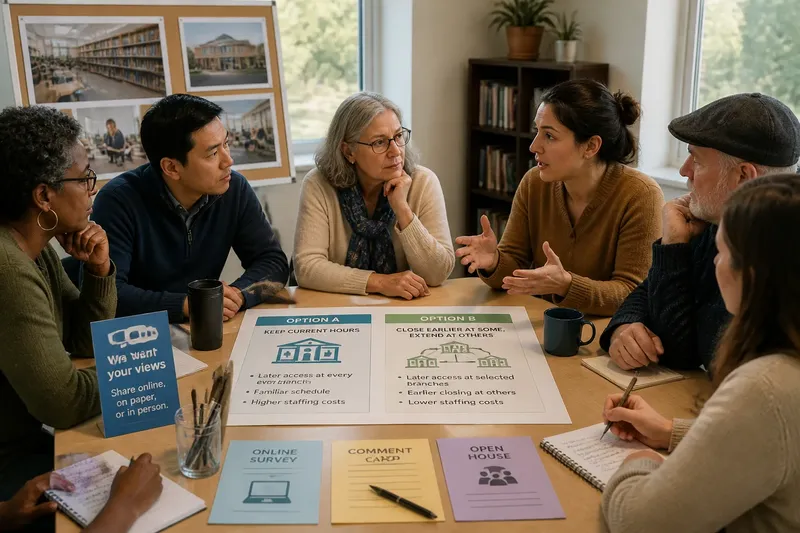
Say a fictional county is considering a referral process between public libraries and a housing-support office. Officials are unsure whether residents will understand a referral card and whether staff know which cases they can send. They first use sample cases to clarify staff responsibilities, then define a limited live pilot and record where residents ask for help or fail to complete the handoff. The resulting decision is to revise the card before launch and specify which referrals each office can accept; the exercise does not establish that the process will work everywhere.
For any proposed learning method, each observation should lead to a visible decision:
- Check whether the policy has a specific unanswered question; if it does, choose a method that can address it, and if it does not, define the question before launching.
- Check whether the uncertainty concerns staff procedures; if it does, begin with a simulation, and if real public behavior is central, consider a bounded live pilot instead.
- Check whether people would have to rely on an unfinished service; if they would, revise the process or use a simulation first, and if they would not, assess whether a live trial is appropriate.
- Check who can access the limited version; if some affected groups would be excluded, adjust the boundary or explain the exclusion, and if access is suitably broad for the question, document who remains outside it.
- Check whether the trial setting resembles the places where a broader policy would operate; if it does, note the relevant similarities, and if it does not, narrow the claim or choose a different setting.
- Check whether officials have stated what would lead them to revise, pause, expand, or stop; if they have, publish those decision points, and if they have not, set them before collecting observations.
Limits that shape lessons
A pilot’s boundaries shape what it can reveal. A program run by a well-resourced city office may face different staffing, transportation, or language-access conditions from one in a rural area. If a trial takes place only where implementation is unusually straightforward, its apparent smoothness may say little about settings with different constraints.
Participation can distort the picture, too. People who hear about a service through a trusted local organization may encounter it differently from residents who receive only a mailed notice. Staff may devote extra attention to a limited trial because it is new. That attention can help identify obstacles, but decision-makers should not assume the same support will be available at wider scale.
A useful pilot makes a modest learning claim. It specifies what will be observed, whose experience matters, and what the trial cannot establish. Records of refusals, delays, questions, and workarounds can be as informative as a smooth transaction. The purpose is to learn how the design meets real conditions, not to stage a demonstration of success.
Questions about policy pilots?
How does a policy pilot differ from a temporary program?
The terms can overlap, but a pilot is defined by its bounded scope and learning purpose. A temporary program may provide a service for a limited period without being designed to inform a later adoption decision.
Can a pilot prove a policy works?
A pilot can provide evidence about the setting and questions it was designed to examine. Its limited scope usually cannot establish that the same design will work across different populations, institutions, or conditions.
Who decides whether a pilot expands?
The relevant public body or authorized institution makes that decision under its own rules. A well-designed pilot states decision criteria in advance, helping readers distinguish a choice based on learning from a separate political judgment.
From learning to decision
The most useful policy pilot is not necessarily the one that points toward expansion. It is the one that helps decision-makers distinguish a fixable delivery problem from a deeper mismatch between the proposal and the people or institutions it affects.
When reading an announcement about policy pilots, look for the learning questions, boundaries, and next decision point. Clear answers let the public judge what a trial may teach and where its limits lie. If those details are absent, “pilot” may describe the scale of a launch without explaining how anyone will learn from it.