The Neutral Policy Myth: Every Design Leaves Some Choices Open
The neutral policy myth can hide who a proposal reaches and how it works. Learn to trace decision authority, administrative rules, and routes for review.
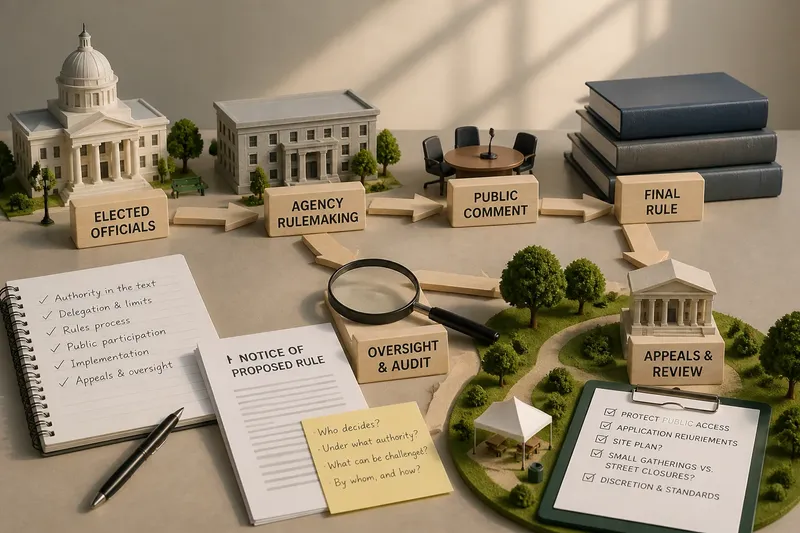
Who decides what a policy will do after elected officials approve it? The neutral policy myth can make those later decisions look like routine administration, even when they determine how a program operates. To read a proposal clearly, follow the authority it assigns, the rules officials must write, and the ways the public can challenge or revise those rules.
That focus shifts attention from whether a policy seems neutral to how institutions turn broad directions into actual decisions. A statute, agency rule, public hearing, and appeals process each have a different job. Knowing which institution controls which part helps readers direct questions to the right place.
Authority in the text
A proposal may set a clear goal while leaving important operating details to an agency, board, or local office. Look for language such as “the department shall establish,” “subject to rules adopted by,” or “as determined by the director.” These phrases indicate who gets to fill in the details and what discretion they may have.
Then distinguish between a direction and a delegation. A direction tells an institution what it must do. A delegation gives it room to decide how to do it. That room may be necessary: administrators often have to turn broad policy into forms, timelines, and procedures. But a reader should be able to identify the limits on that authority.
- If the proposal names a decision-maker, note the office or body; if it does not, ask which institution is expected to act.
- If it sets a clear standard, check whether officials must follow it; if it leaves key terms open, ask who will define them.
- If it delegates rulemaking, look for limits and required procedures; if those are absent, ask how the institution will explain its choices.
- If it gives an agency discretion over exceptions, check what criteria govern them; if none are stated, ask how similar cases will be treated.
- If it assigns duties to local offices, check whether the proposal explains their role; if not, ask how responsibilities will be divided.
- If it identifies an oversight body, check what it can review; if its role is unclear, ask who can correct an implementation problem.
Rules after approval
Legislative approval is not always the end of policy design. An agency may publish proposed rules, invite public comments, revise its draft, and issue a final version. The rulemaking record can show how officials interpreted the law and which concerns they addressed.
Find the responsible agency and its rulemaking page. Search for the proposal’s title or the agency’s notice, then read the proposed text alongside its explanation. The explanation should make clear what the agency thinks the law requires, which options it considered, and how to submit a comment. A comment is more useful when it identifies a specific provision and explains a practical consequence or a possible alternative.
Do not assume that a public comment automatically changes a rule. The agency has to act within its legal authority and follow the procedures that apply. Still, a comment can put a concrete concern on the record and ask the agency to explain its reasoning.
Who can revise the rules?
Different institutions may control different stages of a policy. These questions help identify where a decision belongs.
Can an agency change a law?
An agency generally implements authority granted by law; it does not replace the legislature’s role. If a proposed change appears to go beyond the law, check the enabling statute and the agency’s explanation, then seek qualified legal advice if the question has practical consequences.
Where do public comments go?
Comments usually go to the agency handling the proposed rule, through the method and deadline stated in its notice. Read the notice carefully and keep a copy of what you submit.
Who handles local implementation?
The proposal may assign local duties to a city department, county office, school board, or another local body. Check the text and the relevant institution’s official guidance to see who is responsible for each action.
What can an appeal review?
An appeal route may let a person challenge an individual decision, but its scope depends on the governing rules. Check who can appeal, what decision can be reviewed, and which deadlines or procedures apply; consult a qualified professional when needed.
Public oversight routes
Oversight is not one thing. A legislature may hold a hearing, an agency may answer public comments, an inspector general may review administration, and a court may consider a legal challenge. Each route has its own authority and limits. A hearing can expose unanswered questions without changing the rule; an appeal may address an individual decision without rewriting the program.
To find the route that fits a concern, start with the type of decision at issue. If the question is why an agency adopted a rule, look for its rulemaking record and the officials responsible for oversight. If the issue is a decision about one person or organization, look for an appeal or review procedure. If the concern is whether the agency acted within its legal authority, official guidance may not resolve the question; a qualified lawyer can explain the relevant options.
Follow one decision
Imagine a city council approves a program offering permits for neighborhood events, while directing the city’s parks department to set application requirements. The text says the department must protect public access but does not say whether small gatherings need the same site plan as events that block a street.
A reader can work through the decision in order. First, identify the council’s direction: protect public access. Next, note the delegated task: the parks department sets application requirements. Then find the department’s proposed rule and check whether it distinguishes between park gatherings and street closures. If the draft requires the same plan for both, the reader can comment on that specific requirement, explain how the two settings differ, and ask whether a simpler park application could still address public access. The resulting question is not whether the department has bad motives; it is whether the proposed rule fits the authority and purpose the council provided.
Read the record closely
Institutional explanations often compress several decisions into words such as “consistent,” “efficient,” or “uniform.” Translate those terms into questions about the record: Who is expected to apply the rule? What discretion does the agency retain? Which cases does the explanation address, and which remain unresolved?
Also separate a stated purpose from the institution’s authority. An agency may say a rule will simplify administration, but that claim does not answer whether the law permits the rule or whether the process allows public input. Check the legal basis, the rulemaking notice, and any review mechanism as distinct parts of the proposal.
The neutral policy myth becomes easier to question when the decision-makers and their authority are visible. For any proposal, name the institution that sets the rule, the record where it explains the choice, and the route for review. That simple map gives the next question a clear destination.